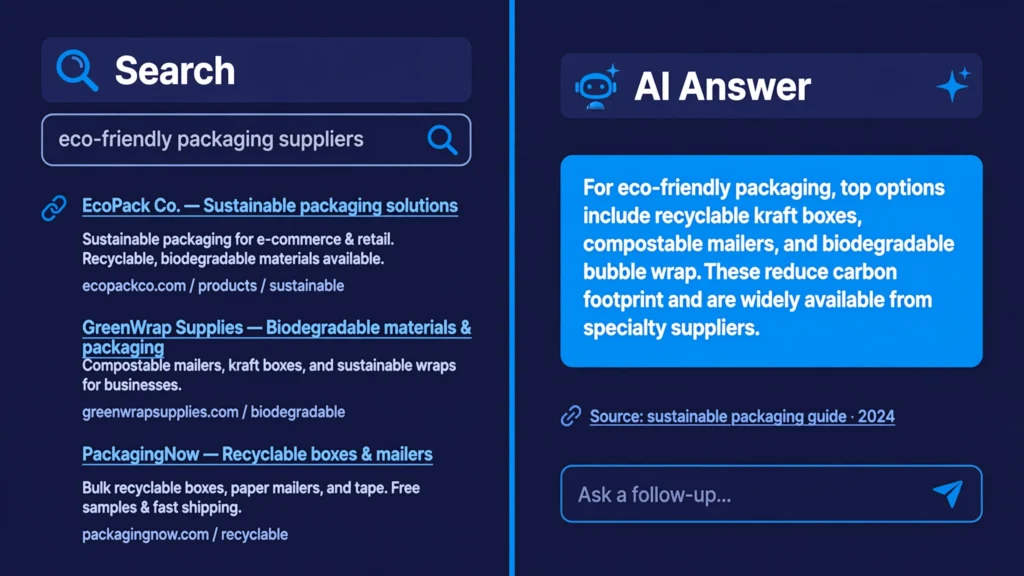
For years, getting found online meant one thing: ranking on page one of Google. Today, a growing share of customers skip the list of links entirely and ask an AI assistant such as ChatGPT, Gemini, Perplexity or Google’s AI Overviews for a direct recommendation. That shift has created a new discipline alongside SEO: Answer Engine Optimisation (AEO).
What is the difference between SEO and AEO?
SEO helps your pages rank in traditional search results. AEO helps your business get mentioned and cited inside AI-generated answers. The good news is that they share the same foundations: a fast, well-structured website, genuinely helpful content, and a strong, consistent reputation across the web.
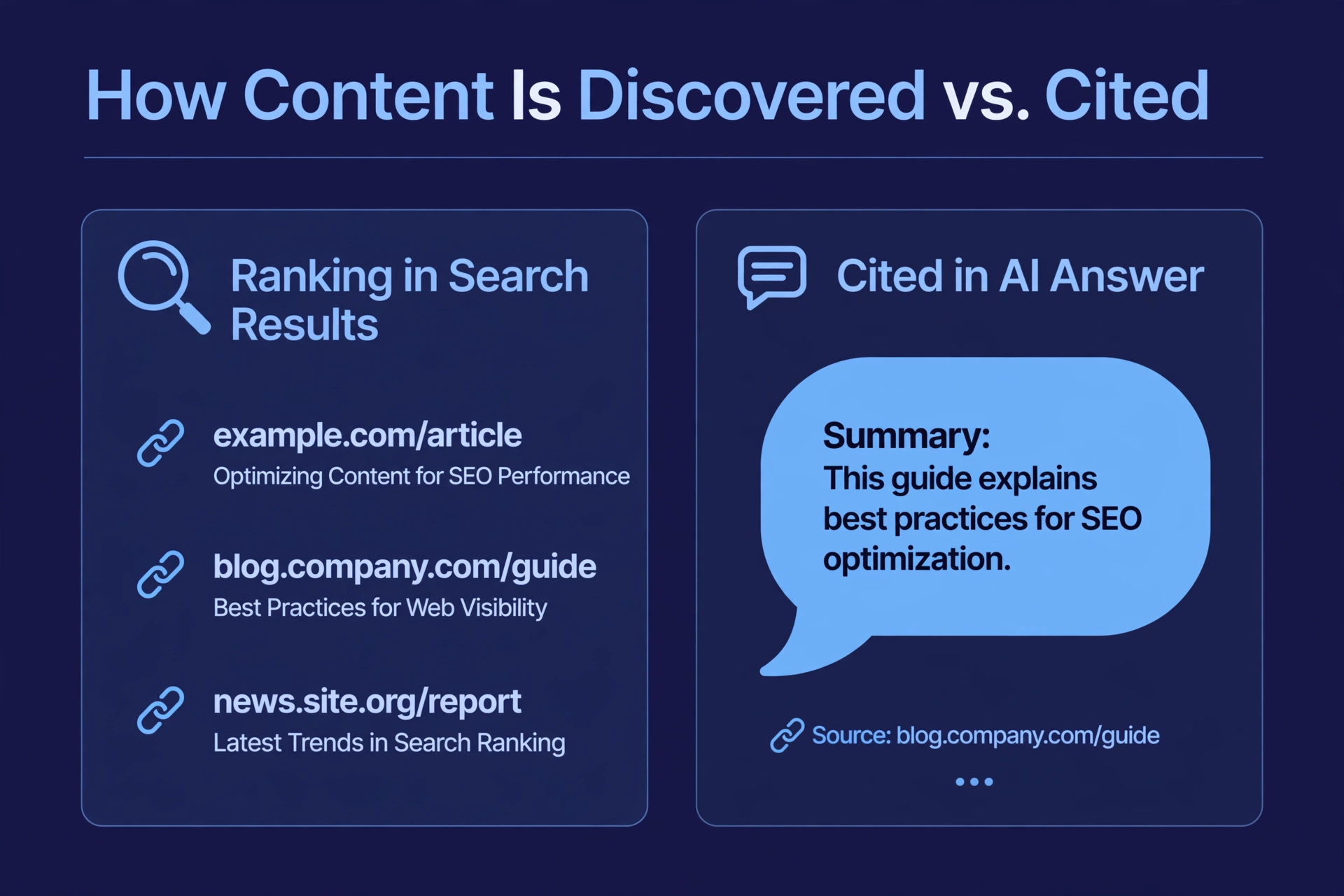
SEO vs AEO side by side
Think about the last time you looked for a service. You probably typed a few words into Google, scanned a page of blue links and chose one to click. Now imagine asking an assistant such as ChatGPT or Gemini the same thing as a full question. Instead of a list, you get a single direct answer — and if a business is named in that answer, the recommendation carries real weight. SEO and AEO are about winning those two different moments.
| SEO | AEO | |
|---|---|---|
| Where you appear | In a list of links on a search results page | Inside the answer the assistant gives |
| What the customer does next | Clicks through to your website to find out more | Reads the answer, and may contact the business named in it without ever browsing a list of links |
| What earns visibility | Relevant, well-structured pages, links from other websites and a technically sound site | Being mentioned and cited as a source, with clear facts the assistant can quote with confidence |
| How results are measured | Rankings, website traffic and enquiries from search | Whether your business is named when customers ask the assistant their questions |
The encouraging part is how much the two overlap. An assistant can only recommend businesses it can find, read and trust — and those are broadly the same businesses that rank well on Google. A fast website, accurate business details and pages that genuinely help customers are not ‘SEO work’ or ‘AEO work’; they are the shared foundation both stand on. That is why the sensible order is to fix the foundations first, then worry about the differences.
What makes an AI assistant mention your business?
AI assistants do not invent their answers from thin air. They piece them together from what they can find across the web: your website, your Google Business Profile, your directory listings, reviews and other sites that talk about businesses like yours. A business is far more likely to be mentioned when that information is easy to find, easy to understand and says the same thing everywhere. Three things matter most.
Clear, quotable answers on your own pages
When a customer asks which company offers a particular service in their town, the assistant looks for pages that answer that kind of question plainly. Vague marketing language is hard to quote, so pages full of it tend to be passed over. A page that states, in its first sentence or two, what you do, who you do it for and where you work gives the assistant something it can lift with confidence. It is the same habit that wins Google’s featured snippets, so one improvement serves both channels.
Consistent business details everywhere
Assistants cross-check what they find. If your website describes one set of services, your Google Business Profile another, and a directory lists an old phone number, the assistant has little reason to trust any of it. Keep your business name, address, phone number, services and opening hours identical everywhere they appear. It is unglamorous admin, but it directly affects whether you are the business that gets recommended — which is why it also appears in the steps below.
Reviews and mentions on sites AI assistants trust
An assistant is more confident about recommending a business that other people already talk about. Reviews on Google and well-known directories, listings in industry directories, coverage in local press and helpful contributions in community forums all act as evidence that your business is real, active and valued by customers. This kind of trust cannot be bought or faked — and attempting to fake it will harm you on Google as well. Ask happy customers for honest reviews, and keep your listings accurate and up to date.
Five steps to improve both
- Answer questions directly. Put a clear, one or two sentence answer near the top of each page, then expand on it. AI tools and featured snippets both favour content that gets to the point.
- Add structured data. Schema markup for your organisation, services, FAQs and reviews helps search engines and AI systems understand exactly what you offer.
- Keep your details consistent. Your business name, services and contact details should match on your website, Google Business Profile, directories and social profiles.
- Earn mentions on trusted sites. Reviews, industry directories, local press and relevant forums are all sources AI models learn from.
- Track real prompts. Each month, ask AI assistants the questions your customers would ask and note whether your business appears.
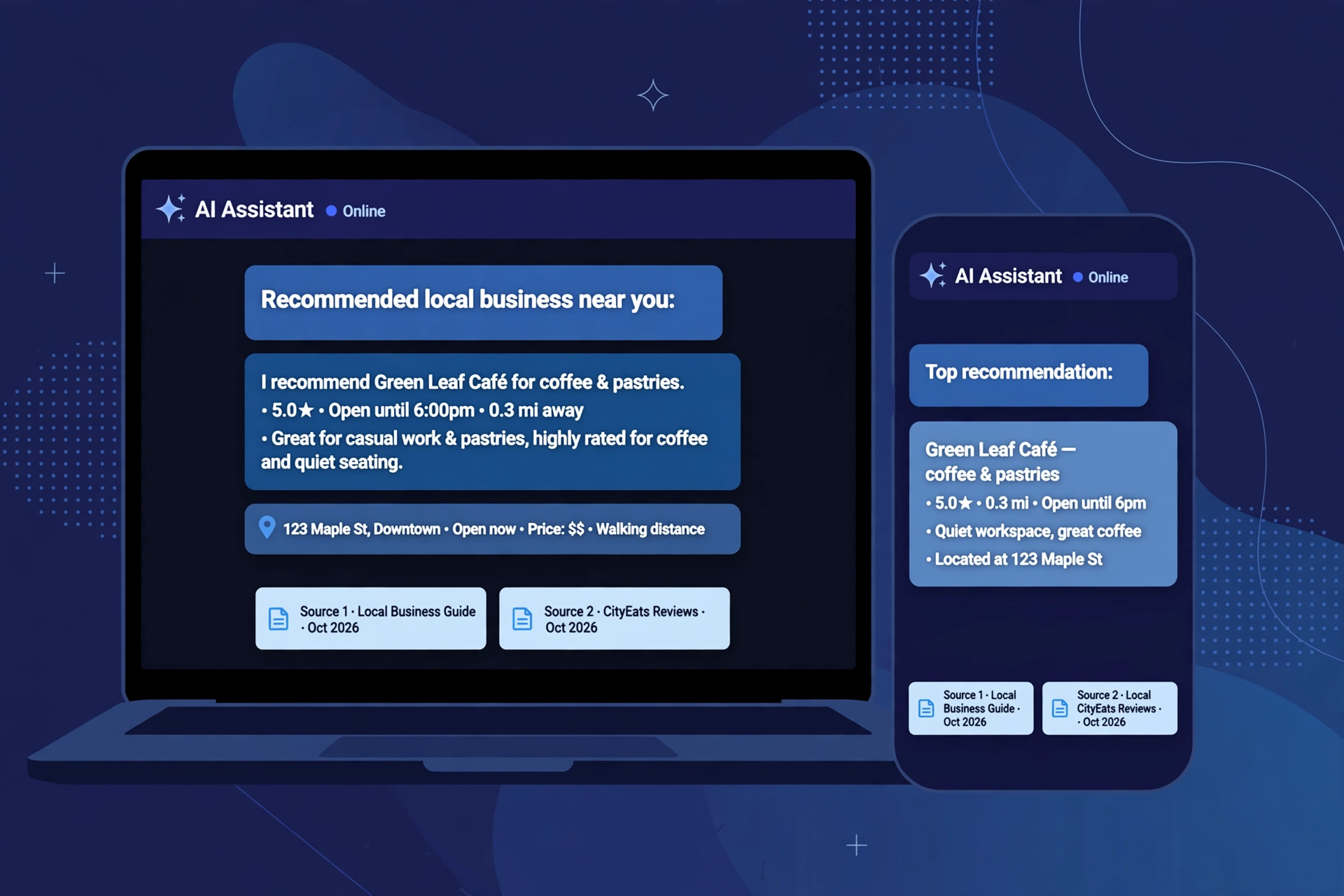
How to check your visibility in Google and AI answers
You do not need specialist software to build a first picture of your visibility. A short routine you can run monthly, using tools you already have, shows whether you appear where customers are actually looking — and whether that picture is improving over time.
Ask the assistants what your customers ask
Write down the questions customers ask you most often, worded the way they would say them: ‘Who is a good web designer near me?’, ‘How much does a small business website cost?’, ‘Who can fix my website?’ Ask each one in ChatGPT, Gemini and Perplexity, and note which businesses get named. Then search the same questions on Google and check where you appear in the results and the map listings. Keep your notes with the date. If the same competitors keep being recommended and you are not, comparing their pages and profiles with yours usually shows what to fix first.
Check the technical basics
Visibility problems are often simple ones. Search Google for your business name plus your town and confirm the right pages come up. Type ‘site:’ followed by your web address into Google to see which pages it has indexed; if important pages are missing, fix that before anything else. Finally, open your website on a phone and check that it loads quickly and every page has a clear title describing what it offers.
Our free AI SEO audit checks these technical basics for you and lists what to fix first.
Where to start
If your website has technical issues or thin content, fix those first: they hold back both SEO and AEO. Then build out pages that answer your customers’ most common questions. If you would like a free review of how visible your business is on Google and in AI answers, book a strategy call with our team.